Sunday, 14 April 2013

BIOLUMINESCENCE


There are summer nights when the Estuary waters glitter.
The boat leaves a wake of sparkling light.
Water burns where the oars dip
And fingers trailed are fireworks.

(One knows one is witnessing a chemical reaction.
Bioluminescence would seem to be the word.
Something to do with living organisms,
Something to do with the Science we were never that good at!)

But look!  I have put all that in parenthesis.
What is outside the brackets is a dazzling miracle.
What is left is light in the water.
Dip your fingers and gasp at the show!

Saturday, 13 April 2013

A TOPSHAM PILOT, 1789.


On October 8th 1797 a Topsham pilot-boat was out at sea plying for trade when she was signalled by a Prussian ship,  some accounts say Russian, some five miles off Bolt Head  but the Prussian ship did not want a pilot, she wanted to offload fourteen British seamen,  two of them grievously wounded,  who had been taken off the frigate 'Quebec'.  On 6th October,  the 'Quebec' had been in a desperate sea battle off Ushant  with the French frigate 'Surveillante'  and the Prussian ship had found 'Quebec' burning and had brought these few survivors back to British waters.  The Topsham pilot must have been dangerously overloaded but she brought the fourteen sailors safely into Salcombe  and into the hands of the principal customs house officer there,  Richard Valentine,  who found doctors and all necessary comforts for the 'poor souls' who had survived.

Just another day's work for a Topsham pilot!!!

Saturday, 30 March 2013

FOG ON THE ESTUARY, 1930


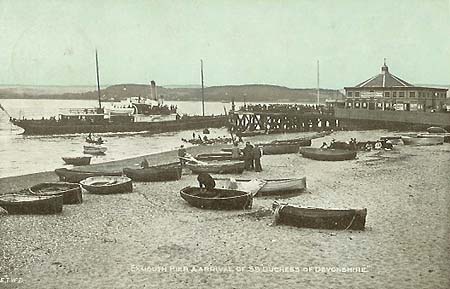
On Tuesday 26th August 1930 there was a sea mist on the South Devon coast.  This didn't deter the Exmouth holidaymakers who crowded aboard those two famous old paddle steamers, 'the Duke and Duchess of Devonshire'.  Both ships had been built in the nineteenth century and,  although nobody on board knew it, they had only a few more years to serve the struggling Devon Dock, Pier and Steamship Company.    The ships arrived safely in Torquay and the visitors had their trip ashore but in the evening  the mist became thick fog.   The ships steamed off and tried to bring their passengers home to Exmouth.  The 'Duchess' left Torquay first and she reached Teignmouth but by then the fog had become so dense the captain decided to sail no farther.   The 'Duke' left Torquay and came round Hope's Nose only to find conditions worsening.  There was a heavy tide running so the captain decided to take his ship back to Torquay to keep out of harm's way.

This left the Dock Company with the challenge of how to return the passengers to their beds in Exmouth.  The decision was made to send them by train to Starcross and then across the foggy Estuary by the Starcross steam ferry.  The little steam launch ferry butted to and fro through the fog,  not once but several times,  and brought nearly all the passengers safely home across the Exe.   The tide prevented the steam launch making her last  journey and the unlucky passengers who were still in Starcross then came home by train via Exeter. It was said to have been the thickest fog on the river for eight years.

I like to think that the trippers, especially the children, enjoyed the adventure.   No doubt there was something of a Dunkirk  (still ten years away!) spirit as they escaped from the beaches of Starcross.
  

Saturday, 23 March 2013

THE LEGS OF BOOTS

Boots have legs and and long boots have long legs.   In my early days as a casual part time fisherman on the Estuary,  that is to say some forty five years ago, I was not paid in money but, after my long day or night's work,  which I was glad to do for the fun of it,  I would be invited to take a few fish home 'for my tea'.   These, generally, were undersized fish which should have been thrown back but which my skipper said would not survive,  not after they had been in the net,  and also damaged fish or fish which were of a protected species,  like perhaps one of the beautiful speckled salmon trout that now and then tore its gills in the net.   To take these home was to risk fines and confiscations and the invariable caution was, 'Take this one, Wayland, but stick it down your boot.'

It was thus that I became a bootlegger and I recall walking ashore with some difficulty at the Lympstone boat shelter, past the eyes of curious neighbours who could not know that a forbidden fish or two was stuffed down the leg of my Dunlop seaboot squashed against the length of my calf.  Being young and foolish,  I rejoiced in this delinquency which seemed to me to be rather dashing.  At home we rejoiced again in eating the freshly caught, ill gotten fish.

The Americans would have us believe that 'bootlegger' is a word first used in the American West when traders sold liquor to the Indians illegally by putting flat bottles down the legs of their boots.  The word is thus first recorded only in 1855 but the upper part of a tall boot has been called a bootleg since long before the Pilgrim Fathers sailed from Plymouth and it seems to me altogether unlikely that throughout those several centuries before the West was won, no English, Welsh, Scottish or Irish thief or poacher ever had the wit to talk about  'bootleggers' and 'bootlegging' with reference to this particular way to move and hide illicit goods

Wednesday, 27 February 2013

EAST DEVON MOTOR EXPERIMENTS, 1919

In the Spring of 1919 there were experiments being carried out at Beer to see if the East Devon fishing fleets could benefit from fishing boats being fitted with motors.   The Devon Sea Fisheries Committee reported on these trials and the 'Fish Trade Gazette' commented on the Committee's report.   The Gazette was not convinced  that the trials had been necessary.   It seemed pretty obvious to the Gazette that fishermen would want to use motors.

"To praise and point to the greater efficiency of motor power should be superfluous now;  it is like painting the lily and gilding refined gold  -   it is a 'ridiculous excess'    The fisherman with brains is converted.   But the problem is how to get the cash for the engine. Here the Government can help through various channels....    If the Government is slow to act,  why should not the makers of the motors develop the hire purchase scheme on a large scale?   As we know the risk of bad debts is small and the profits should be sufficient to discount such as there may be.   Fishermen are slow to learn;   they are intensely conservative;  but they are as honest as they are brave,  and no class of men could ask for a higher testimony."

Here on the Estuary it was some years before the honest, brave fishermen had their engines.  Whether from slowness, conservatism or shortage of cash, the fishing fleets were still under sail well into the nineteen twenties.   The boats were still constrained to lie at sea for days and nights when the breezes were unfavourable.   In due time all that was to change  and the sight of boats with  tan sails passing silently across the bar, out to sea and back again and up and down the Estuary would be lost for ever.  

Tuesday, 12 February 2013

THE EXMOUTH LIFEBOAT, 1867.

From: 'Devonshire,  containing historical, biographical and descriptive Notices of Exmouth and its Neighbourhood  &c. by W. Everitt  and published by S Drayton and Sons,  Exeter,  1867:


"The Exmouth boat is on the improved model of Peake and Washington, with air-tight compartments at both ends; air-tight boxes along the sides;  and with copper tubes in the centre, passing quite through the boat, with downward opening valves; so that when a sea is shipped, the weight and impetus of it open the valves and give it an outlet, whilst the water seeking to ascend keeps them usually closed.   Ample appliances of ropes, grapnels, anchors, hatchets, lifebuoys, and cork jackets provide for varied emergency;  and ingeniously constructed rowlocks make the oars self-protecting.  The keel is of iron, with well-adjusted wood and cork ballast,  and the boat is much higher at the air-tight poop ends than along the sides;  so that, in case of capsizing,  she floats on the high ends,  and being free in the middle and heaviest along the keel,-  momentarily her top, - she rolls over by mere gravitation, and so rights herself.   The boat is at all times kept ready mounted on a four wheel truck;  and the "Wreck and Salvage Act" provides ample power to get horses,  wherever horses are to be had."


This was the lifeboat which Charles Dickens wrote up in 1862 and to the cost of which Lady Rolle contributed, and not with two fingers!   It sounds a bit alarming that someone had to go looking for horses before the boat could put to sea


Saturday, 9 February 2013

MUSOPOLUS

"Musopolus" is the pen name of a truly awful Victorian poet who was collected by William Everitt in his anthology of Devon verses.  William  Everitt is our old friend William John Wesley Webb under another name.   The last three stanzas here are perhaps of interest giving evidence of stone boats sailing to and from  Budleigh kilns at the time that this fulsome work was composed which seems to have been the eighteen sixties.

A JUNE EVENING NEAR BUDLEIGH SALTERTON

By Musopolus

By river marge and rushy fen
The lights proclaim 'tis evensong;
And woods grow darker to the ken,
While swift and swallow dart along.

Across the timber bridge I see
Long files of bleating sheep go by;
Now scattering here and there they flee,
And now the sloping fields reply.

A gloomy furnace seems to glow
Behind yon western hills of fir
Methinks a blacksmith wind should blow
Heaven's lazy smouldering fires to stir.

But lo!  that edge of golden gleam
Eating the vapours as they rise,
And now before the setting beam
Splits the piled carbon of the skies.

The stream was falling as I went
'tis falling now as I return;
With ebb and flow alike content
From eve to eve, and morn by morn.

In this remote and silent scene
Of pasture, flats and oozy lake,
What common sights are hailed, I ween,
A flagging fantasy to wake.

Here weeds have virtues of their own,
Here thistles rank as purple kings
And sandy cliffs with beech o'ergrown
Are grand indeed 'mid humbler things.

The dusty kiln in this dim light
Some ruinous old fort appears
E'en yon red bluff's unnoticed height
A mystery on its forehead wears.

The heavy lime boats are away-
Their sails were flapping at the shore
An hour ago.  With parting day
They hasten now the gray seas o'er..

The stream pours back its borrowed salt,
The barges push across the foam,
They have a task that does not halt,
And I the gazer, - I've my home.